

As an affiliate, we may earn a commission from qualifying purchases. We get commissions for purchases made through links on this website from Amazon and other third parties.
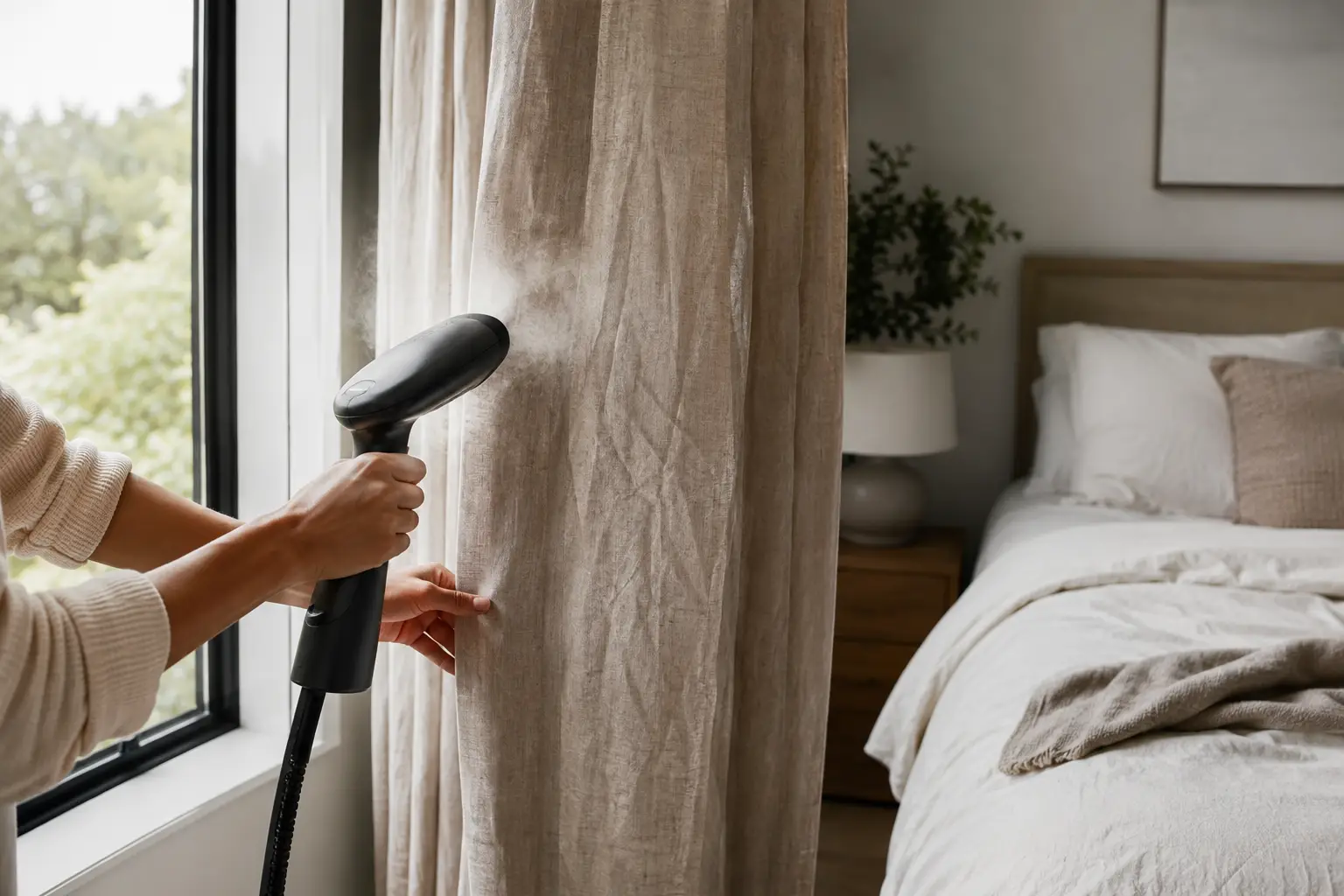
The best steamer for bedding and curtains depends on the size of the job. A fast handheld is great for a bed skirt, pillow sham, or one wrinkled panel. Full-length curtains and several large fabric pieces need more runtime, a longer cord or hose, and fewer refill stops.
Before steam-cleaning bedding, confirm material compatibility and avoid leaving excess moisture in thick fabric or padding.
Steam is mainly a wrinkle-refresh tool. It does not replace washing, stain removal, or proper sanitation. Always check the fabric care label first, especially on coated curtains, delicate trims, waterproof layers, foam, and heat-sensitive materials. Let damp fabric dry fully before putting bedding back into use or closing curtains against a wall.
For using steam cleaners on bedding, follow the care label, test a hidden area, and allow the item to dry completely.
Best Overall
Best for Whole Rooms
Best Reach
Steamers at a Glance
| Product | Format | Runtime | Warm-up | Main strength | Main caution |
|---|---|---|---|---|---|
| Conair Turbo ExtremeSteam | Handheld | About 20 min | About 40 sec | Strong handheld balance for curtain panels | Can sputter or produce weak output |
| Pure Enrichment PureSteam XL | Standing | Up to 1 hour | About 45 sec | Whole-room curtains, bedding, upholstery | Bulkier; hose and spray behavior need care |
| BLACK+DECKER Advanced | Handheld | Longer-session handheld | Under 1 min | 15-ft cord and useful textile attachments | Can leave water spots if used before fully hot |
| Conair 2-in-1 Steamer and Iron | Handheld | About 10 min | About 10 sec | Fast touch-ups and horizontal pressing | Shorter tank life for room-scale jobs |
| Hamilton Beach Handheld | Handheld | Up to 20 min | About 45 sec | Lighter mid-size option | Water spitting can develop over time |
| BEAUTURAL Handheld | Handheld | About 15 min | About 30 sec | Compact vertical or horizontal use | Can leak or spray water over time |
Match the Steamer to the Job Size
Quick touch-up: about 10 minutes
A short-runtime handheld is enough for a wrinkled pillow sham, bed skirt section, removable cover, or one small curtain area. Fast heat-up matters more here than a huge tank because you want to fix one problem and put the tool away.
Before ironing versus steaming curtains, confirm material compatibility and avoid leaving excess moisture in thick fabric or padding.
One or two curtain panels: about 15 to 20 minutes
Curtains take longer because you work from top to bottom and may need several passes on deep fold lines. A 15- to 20-minute handheld gives you more useful working time without the storage footprint of a standing unit. Cord length also matters once you reach the outer edge of a wide window.
Whole-room refresh: long tank and hose
Several curtain panels, upholstered pieces, and bedding surfaces can turn a handheld refill into the slowest part of the job. A standing steamer with a large tank is easier for a long session. The tradeoff is floor space, hose handling, and more equipment to store afterward.
What to Check Before Steaming Bedding or Curtains
Care label and fabric finish
Plain cotton, linen blends, polyester, and some other common fabrics may tolerate steam when their care instructions allow it. Coatings, glued details, blackout backings, waterproof membranes, velvet, delicate trims, and heat-sensitive synthetics need more caution.
Test an inconspicuous area if the manufacturer directs you to check colorfastness. Do not assume a curtain front and its lining can handle the same heat.
Vertical or horizontal use
Curtains are naturally a vertical job. Bedding is often easier to work on horizontally, but not every steamer is designed to operate that way. If you want to refresh a duvet cover or bed skirt while it is laid out, choose a model designed for horizontal steaming.
Runtime and refill access
A bigger tank is useful only if you can comfortably hold the steamer. Handheld models put the water weight in your hand. Standing units move that weight to the floor but add a hose.
Water behavior
Sputtering and water spots are recurring steamer problems. They can appear when a unit is not fully heated, when mineral buildup develops, or when a seal or water path begins to fail. Give the steamer its full warm-up time and follow the manual's water and cleaning directions.
The Best Steam Refresh Kits for Bedding and Curtains
1 / 6
Conair Turbo ExtremeSteam 1875W Handheld Steamer

Format
Handheld
Power
1875 W
Runtime
Up to about 20 minutes
Warm-up
About 40 seconds
Attachments
Silicone band, delicate spacer, bristle brush
This Conair is the best all-around match for curtains and fabric refresh jobs because it combines 1875 watts with up to about 20 minutes of steam time. That is long enough to work through a curtain panel or several lighter fabric pieces without jumping to a standing unit. The silicone band helps hold fabric taut, the spacer adds control around delicates, and the brush is useful on thicker textiles.
The main caution is water consistency. The unit can sputter, leak, or produce weak output, although it can also deliver strong, steady steam. Let the machine come fully to temperature, keep it moving, and stop if it begins spraying water instead of producing steady steam.
Why It Works
- About 20 minutes of runtime suits curtains better than a 10-minute tank.
- High power and a heated plate help with stubborn fold lines.
- The attachment set covers delicate and thicker fabric jobs.
- A handheld body is easier to store than a standing system.
What To Keep In Mind
- Steam consistency can vary from strong output to sputtering or weak steam.
- Thick cotton can still need repeated passes.
- Do not press a hot plate against fabric unless the fabric and tool directions support contact.
2 / 6
Pure Enrichment PureSteam XL Standing Fabric Steamer

Format
Standing steamer
Tank
Half gallon
Runtime
Up to about 1 hour
Warm-up
About 45 seconds
Reach
5-ft hose plus 7-ft power cord
PureSteam XL is the room-scale choice. Its half-gallon tank supports up to about an hour of steam, and the standing design puts the water weight on the floor instead of in your hand. Its listed uses include bedding, curtains, upholstery, clothing, and delicate fabrics, making it the clearest fit for a long refresh session across several large items.
The tradeoff is handling. A standing unit takes more storage space, and the hose can feel rigid or awkward in certain positions. The head can also spray intermittently and leave water spots. Keep the hose arranged as directed, allow full warm-up, and give fabric time to dry before folding or closing it against a wall.
Why It Works
- The long runtime reduces refill stops across several panels or bedding pieces.
- Wheels make a larger unit easier to move from room to room.
- It is designed for bedding, curtains, and upholstery as well as clothing.
- A hose and standing base keep the tank weight out of your hand.
What To Keep In Mind
- It needs more floor and storage space than a handheld.
- The hose can be less flexible than expected.
- Stop if the head begins spraying enough water to leave wet spots.
3 / 6
BLACK+DECKER 1400W Advanced Handheld Steamer

Format
Handheld
Power
1400 W
Cord
15 ft
Steam control
Continuous-steam lock
Attachments
Lint, delicate and upholstery frames
BLACK+DECKER is the reach pick for hanging curtains and larger fabric surfaces. A 15-foot cord gives you more freedom around wide windows, tall rods, and beds that are not right beside an outlet. The continuous-steam lock also reduces the need to keep a trigger pressed during a longer panel, while the delicate and upholstery frames give the tool useful fabric-specific roles.
Warm-up discipline matters with this model. Starting before it is fully hot can lead to leaking and water spots, so "almost ready" is not ready enough. Wait for the unit to reach full operating temperature before moving toward the fabric, and test a hidden area when the material or finish is uncertain.
Why It Works
- The 15-foot cord is the strongest reach advantage among these picks.
- Continuous steam is convenient on long curtain panels.
- Dedicated delicate and upholstery attachments widen its practical use.
- The handheld form is easier to move around a bed than a standing base.
What To Keep In Mind
- Using it too early can lead to water instead of clean steam.
- The longer cord needs safe routing so it is not a trip hazard.
- Attachment choice does not override a fabric care label.
4 / 6
Conair 2-in-1 Handheld Steamer and Iron

Format
Handheld steamer and iron
Power
1875 W
Warm-up
About 10 seconds
Runtime
Up to about 10 minutes
Steam levels
4
The Conair 2-in-1 is the quickest-starting option here. It heats in about 10 seconds, offers four steam levels, and has a plate designed for vertical or horizontal use. That makes it useful when a bed skirt, sham, duvet cover edge, or single curtain section needs attention and you do not want to set up a larger system.
Its 10-minute tank is the reason it sits below the longer-runtime models for curtains. You can finish a small job quickly, but full-room work is likely to mean refilling. Cotton can also be slow to finish even with the higher power, so fast heat-up should not be confused with instant wrinkle removal on every fabric.
Why It Works
- About 10-second warm-up is ideal for small last-minute jobs.
- Vertical and horizontal support suits both hanging and flat fabric.
- Four steam levels give more control than a one-setting tool.
- The plate can handle iron-like finishing when the fabric directions allow it.
What To Keep In Mind
- About 10 minutes of runtime is short for several curtain panels.
- Dense cotton may need more time than the quick-start design suggests.
- Secure the water-tank stopper carefully after refilling.
5 / 6
Hamilton Beach 1200W Handheld Garment Steamer
Format
Handheld
Power
1200 W
Tank
400 ml
Runtime
Up to about 20 minutes
Warm-up
About 45 seconds
Hamilton Beach gives you a useful middle ground: a lighter handheld body with a 400 ml tank and up to about 20 minutes of steam. That is enough working time for several light items or a modest curtain job without carrying the bulk of the larger Conair. The ergonomic shape also matters when you are holding the tool at shoulder height for a long panel.
It is not the heavy-duty choice. It is better for light wrinkles, and water spitting can develop over time even when the unit worked cleanly at first. If output changes from steam to droplets, stop rather than continuing across a curtain or clean duvet cover.
Why It Works
- The 20-minute runtime is generous for a lighter handheld.
- A detachable 400 ml tank reduces refill frequency.
- The shape is comfortable for longer handheld use.
- It suits several lightly wrinkled items in one session.
What To Keep In Mind
- It is less convincing on heavy-duty wrinkle jobs.
- Water spitting can appear with age or use.
- Let wet spots dry completely before putting fabric back against other surfaces.
6 / 6
BEAUTURAL Portable Handheld Steamer

Format
Handheld
Power
1200 W
Warm-up
About 30 seconds
Runtime
About 15 minutes
Use
Vertical or horizontal
BEAUTURAL is a compact option when you want both vertical and horizontal steaming without a large tank or standing base. It heats in about 30 seconds, runs for roughly 15 minutes, and includes brush attachments for different fabric jobs. That combination works well for travel, small curtain sections, and lighter bedding pieces whose care labels allow steam.
The leak-free description does not hold up consistently over time. Steam can become intermittent, and the head can spray enough water to leave spots. Buy it for its compact orientation flexibility, not because you expect a permanent no-drip guarantee.
Why It Works
- Vertical and horizontal operation is useful across curtains and bedding.
- About 15 minutes balances portability with useful runtime.
- The detachable tank is easier to refill than a sealed body.
- A 30-second warm-up keeps small jobs quick.
What To Keep In Mind
- Leak-free performance is not dependable enough to treat as a guarantee.
- Water spray can mark clean fabric until it dries.
- Keep the appliance away from children and follow the operating directions exactly.
Which Attachments Actually Help?
A delicate spacer or bonnet creates distance between a hot plate and a sensitive fabric. It can be useful on light curtains and fine textiles, but it does not make an otherwise unsafe fabric steam-safe.
A bristle or upholstery brush can help steam reach thicker fibers. It is more useful on sturdy curtains and upholstery-like textiles than on very fine material.
A silicone band or taut-fabric tool holds the textile flatter so wrinkles are easier to relax. This is useful on hanging panels where you do not have an ironing board behind the fabric.
A creaser or iron-like plate is mainly for sharper finishing. Bedding rarely needs a hard crease, but a heated plate can help on a duvet-cover edge or stubborn curtain fold when direct contact is allowed.
How to Steam Curtains Without Making Water Spots
- Check the front fabric and lining. Treat the curtain as a layered item, not just the visible face fabric.
- Fill the tank as directed. Use the water type specified in the manual.
- Let the steamer fully heat. Do not start just because the first small puff appears.
- Test a hidden area. Watch for color change, coating damage, shine, or water marks.
- Work from the top down. Gravity helps the fabric hang as wrinkles relax.
- Keep the head moving. Holding concentrated heat in one place can damage fabric.
- Stop if the unit spits. Fix the water or heat issue before continuing.
- Let curtains dry open. Do not press damp panels against painted walls or window trim.
How to Steam Bedding Safely
Bedding should be clean before steaming. Steam can improve appearance, but it does not remove body oils, spills, pet messes, or detergent residue.
For a duvet cover, sham, or bed skirt, you can work vertically or horizontally if both the fabric and the steamer support that orientation. Avoid steaming directly into foam, electrical bedding, waterproof membranes, or filled items whose care instructions warn against heat or moisture.
Leave enough drying time afterward. A damp fabric layer trapped against a mattress, fill, or wall is a poor trade for fewer wrinkles.
Frequently Asked Questions
What is the best steamer for full curtain panels?
The 20-minute Conair Turbo ExtremeSteam is the best handheld balance for curtain panels. If you have several rooms or many large textiles, the PureSteam XL standing model offers up to about an hour of runtime.
Is a handheld or standing steamer better for bedding?
A handheld is easier for small bedding pieces and occasional touch-ups. A standing steamer is better when you have several large surfaces and want a long session without frequent refills.
Can I steam a comforter on the bed?
Only if the care instructions allow steam and the surface material can tolerate the heat and moisture. Avoid trapping dampness in the fill, and never assume a steamer is suitable for foam, waterproof layers, or electrical bedding.
Can I steam blackout curtains?
Use extra caution. Blackout curtains may have coatings or bonded layers that react differently from the face fabric. Check the care label and manufacturer guidance before applying steam.
Why is my steamer spitting water?
The unit may not be fully heated, mineral buildup may be affecting the steam path, or a seal or component may be failing. Stop using it on the fabric until the cause is corrected.
How long should I let curtains dry after steaming?
Let them dry completely before pressing them against a wall, tying them back tightly, or closing them into a poorly ventilated space. Drying time depends on how much moisture the fabric picked up and the room airflow.
Does more wattage always mean better wrinkle removal?
No. Power matters, but steam consistency, plate design, runtime, fabric weight, and technique also affect the result. A high-power handheld with a small tank can still be less convenient for a whole room than a lower-power unit with longer runtime.
Can steam sanitize bedding?
Do not rely on a garment steamer as a sanitation method unless the exact appliance, exposure conditions, and manufacturer directions support that use. For this roundup, treat steaming as wrinkle refreshing rather than a hygiene guarantee.
Before using steam on a bed, whether you should steam bedding explains which materials and constructions need extra caution. For window treatments, how to steam curtains safely covers care labels, linings, colorfastness, moisture, and drying. If you are unsure about a material, which fabrics should not be steamed is the best check before putting a hot steamer near the surface.
