

As an affiliate, we may earn a commission from qualifying purchases. We get commissions for purchases made through links on this website from Amazon and other third parties.
A comforter is a different steaming job from a shirt. The surface is larger, the fill can trap moisture, and a small handheld tank may run dry before you finish one side. For full-size comforters, a standing steamer usually makes more sense because it gives you a larger reservoir, longer continuous runtime, and a hose you can move across a supported surface.
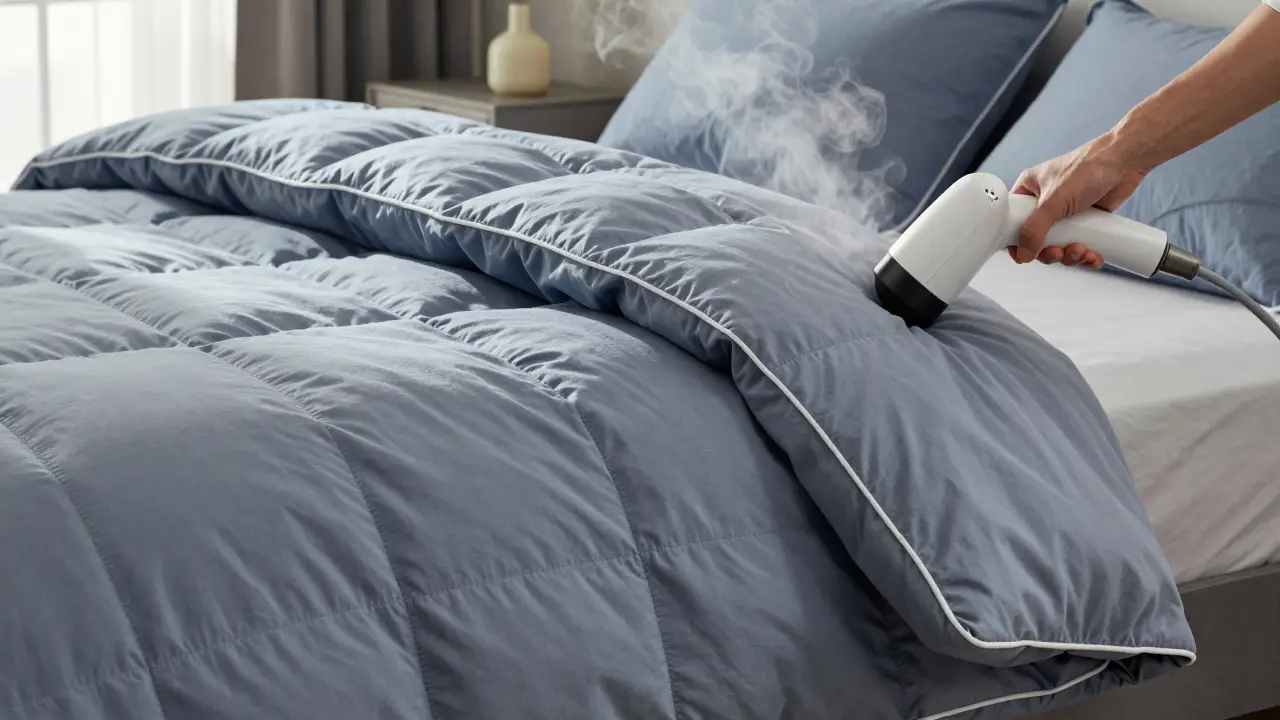
For steaming a comforter safely, follow the care label, test a hidden area, and allow the item to dry completely.
Steam should be treated as a surface wrinkle treatment, not deep cleaning. Check the shell and fill care instructions first, keep the steam moving, avoid soaking the comforter, and do not put it back on the bed until it is dry through the treated areas.
The practical test for comforter buying criteria is whether the measured dimensions still provide the intended coverage or support in use.
Best Overall
Best Simple Long-Runtime Pick
Best Large-Tank Pick
Quick Comparison
| Pick | Format | Tank/runtime | Best fit |
|---|---|---|---|
| SALAV GS18 | Standing | 1.8 L, over 60 min | Direct bedding support with wheels |
| Jiffy J-2000 | Standing | About 90 min | Simple long sessions |
| SALAV Commercial | Standing | 3 L, over 90 min | Large-capacity room-scale work |
| Rowenta IS8440 | Standing | Conflicting tank figures; fast 45-sec heat-up | Press screen and handle controls |
| Jiffy J-4000 | Standing | 3.79 L, up to 2 hr | Very long heavy-duty sessions |
| Conair Turbo ExtremeSteam | Handheld | 7.3 oz, up to 20 min | Small comforter sections and storage ease |
The 6 Best Fabric Steamers for Comforters
1 / 6
SALAV GS18 Full-Size Clothes Steamer

Power
1500 W
Tank
1.8 L
Runtime
Over 60 minutes
Mobility
Wheels and adjustable pole
SALAV GS18 is the best fit for comforters because bedding is directly included among its intended household uses and the 1.8-liter tank supports more than an hour of continuous steam. Wheels and an adjustable pole make it easier to move around a large bed than a fixed countertop setup, and an included descaler points to the maintenance a standing steamer actually needs.
The main ownership risk is mineral buildup and control wear. White residue, a loose power control, and early failure appear in customer experiences. Use the recommended water, descale on schedule, and stop if output becomes weak or gurgly rather than trying to compensate by holding the head against the comforter.
Why It Works
- Direct support for bedding use.
- More than 60 minutes of steam reduces refill stops.
- Wheels and a telescoping support make room-scale work easier.
What To Keep In Mind
- Mineral buildup can reduce output and shorten life.
- Keep the hose positioned so it does not kink or gurgle.
- Steam only the surface and allow complete drying.
2 / 6
Jiffy J-2000 Garment Steamer

Power
1300 W
Runtime
About 90 minutes
Cord
7 ft
Hose
5.5 ft
Jiffy J-2000 keeps the design simple: a long-running standing base, a 5.5-foot hose, a six-inch plastic steam head, and about 90 minutes of steam from one fill. The plastic head is lighter than a metal one, which helps during a long pass around a comforter.
The head still gets hot enough that extended use can be uncomfortable. Set up a safe place to rest it, keep hands away from the steam path, and use a heat-protective glove only if the product instructions allow it. The three-year warranty is a useful ownership advantage for a machine meant for repeated use.
Why It Works
- About 90 minutes of runtime suits large textiles.
- Lightweight plastic head reduces some hand fatigue.
- Simple controls avoid unnecessary mode switching.
What To Keep In Mind
- The steam head becomes very hot.
- A standing unit needs floor space near the bed.
- Long runtime still does not justify saturating comforter fill.
3 / 6
SALAV Heavy Duty Commercial Full-Size Steamer

Power
1800 W
Tank
3 L
Runtime
Over 90 minutes
Controls
Foot pedals
SALAV's commercial-style steamer is the capacity choice. Its three-liter tank supports more than 90 minutes of steam, while foot controls, rolling wheels, and a wide support bar make sense when you want a semi-permanent steaming station rather than a tool you store in a drawer.
The tradeoff is bulk and output consistency. Some users report weak initial steam or clanking during warm-up. Keep the hose upright enough for proper flow and give the machine its normal warm-up time before deciding it needs more water or a different setting.
Why It Works
- Three-liter tank minimizes refill interruptions.
- Foot controls keep your hands focused on the textile and steam head.
- Rolling base helps reposition around a large comforter.
What To Keep In Mind
- It is the bulkiest style in this group.
- Weak steam or clanking can signal setup or performance trouble.
- Soft synthetic fabric should never be held under hot steam too long.
4 / 6
Rowenta IS8440 Full-Size Steamer

Power
1700 W
Heat-up
45 seconds
Steam
35 g/min
Control
4 handle settings
Rowenta IS8440 adds a press screen, four steam settings on the handle, wheels, auto-off, and a quick 45-second heat-up. Those controls help when the comforter shell needs a more supported surface than free hanging.
Its prep contains conflicting tank figures, so tank capacity is not a reason to rank it higher. Customer experiences also include hose-flow problems, leaking, and durability concerns. Choose it for the press screen and controls, not for an uncertain capacity claim.
Why It Works
- Fast standing-steamer warm-up.
- Press screen helps support fabric while steaming.
- Four settings give more output control.
What To Keep In Mind
- Tank figures conflict, so plan around actual use rather than a capacity number.
- Hose bends can reduce steam flow.
- Leaks near electrical equipment are a stop-use condition.
5 / 6
Jiffy J-4000 Garment Steamer

Power
1500 W
Tank
3.79 L
Runtime
Up to 2 hours
Housing
Die-cast base
Jiffy J-4000 is built around a very large 3.79-liter reservoir and up to two hours of steam. That makes it the endurance pick if you are steaming several large household textiles in one session rather than one comforter every few weeks.
Capacity comes with inconvenience. Customer experiences describe roughly 15 minutes to reach full steam, and serious leaks can create a puddle under the base. Regular cleaning is important because mineral residue can build in a machine that holds this much water.
Why It Works
- Largest stated reservoir in this group.
- Up to two hours of steam supports repeated large jobs.
- Heavy-duty housing suits a fixed steaming station.
What To Keep In Mind
- Warm-up can take much longer than the smaller picks.
- Leakage is a serious electrical and floor-safety concern.
- Clean mineral residue regularly.
6 / 6
Conair Turbo ExtremeSteam Handheld

Power
1875 W
Tank
7.3 oz
Heat-up
40 seconds
Runtime
Up to 20 minutes
Conair Turbo ExtremeSteam is the only handheld in this comforter group. Its 20-minute supported runtime, quick warm-up, and three fabric attachments make it easy to pull out for a wrinkled corner, visible top panel, or small guest-room touch-up.
It is not the best tool for steaming an entire thick comforter. The tank is small compared with a standing system, and sputtering or weak results on heavier fabric appear in customer experiences. Use it where portability matters more than uninterrupted coverage.
Why It Works
- Easy to store and carry around the bed.
- Twenty minutes is useful for section work.
- Attachments help manage fabric tension and spacing.
What To Keep In Mind
- Small reservoir means more refills on a full comforter.
- Thick fabric can take more time and steam than a handheld handles comfortably.
- Stop if the unit spits water onto the shell.
How to Steam a Comforter Without Trapping Moisture
Check both shell and fill guidance
A comforter has more than one material layer. Heat or moisture that is safe for the outer fabric may still be a poor match for down, foam-like fill, coatings, adhesives, decorative trims, or specialty construction.
Support the comforter instead of bunching it
Hang it over a sturdy support or spread one section flat so the steam can escape. Avoid folding several thick layers together and steaming through them.
Use surface passes
Keep the head moving and use only enough steam to relax wrinkles. The goal is not to drive moisture into the fill. If the shell feels wet rather than slightly warm or damp, stop and let it dry.
Give both sides airflow
After steaming, hang or spread the comforter where air can reach the treated areas. Do not put it under a duvet cover or on the bed until it is completely dry.
Descale the steamer
Large standing machines process a lot of water. Follow the model's descaling routine, drain the tank before long storage, and clean any mineral residue before it starts reducing steam output.
Frequently Asked Questions
What is the best steamer for a comforter?
SALAV GS18 is the best overall fit here because it directly supports bedding, runs for more than an hour, and uses wheels plus an adjustable pole for large-area work.
Is a standing steamer better than a handheld for comforters?
Usually, if you plan to cover a full comforter. Standing steamers hold much more water and run longer. A handheld is easier to store and works well for small visible sections.
Can I steam a down comforter?
Only when the comforter's care guidance permits steam. Thick fill can trap moisture, so use light surface passes and allow complete drying before use.
How long should a comforter dry after steaming?
There is no single time because fabric, fill, room humidity, and how much steam you used all matter. Wait until every treated area feels completely dry and cool before making the bed.
Why does a standing steamer spit or gurgle?
A kinked hose, mineral buildup, an overfilled or poorly seated tank, or a unit that has not fully warmed can affect steam flow. Follow the model's troubleshooting steps and stop if hot water leaks onto the floor or fabric.
Can steam replace washing a comforter?
No. Steam can relax wrinkles on a compatible surface, but it does not remove body oils, stains, dirt, or deep odor the way proper cleaning does.
Before steaming a thick filled item, read where steam can be used on a bed for moisture limits. If you are still deciding whether a steamer earns storage space, whether fabric steamers are worth it compares touch-ups with washing and ironing. For lighter sheets and covers, how clothes steamers work on bedding explains where handheld models make more sense.
