


As an affiliate, we may earn a commission from qualifying purchases. We get commissions for purchases made through links on this website from Amazon and other third parties.
A pillow marketed for neck pain is still a fit purchase, not a treatment. The important variables are head height, the length and shape of the neck support, firmness, shoulder position, and whether you spend most of the night on your back or side.
Claims about pillow-related headaches should be separated from medical advice and judged alongside fit, materials, hygiene, and individual symptoms.
Five picks here use structured cervical geometry, while one uses adjustable loose fill in a conventional rectangular pillow. That gives you two very different paths: commit to a defined head-and-neck cradle, or tune a more flexible pillow until the loft feels right.
Assess side-sleeper pillows through material quality, construction, usable dimensions, maintenance, and household needs.
This guide compares bedding fit and comfort only. Persistent, severe, worsening, or injury-related neck pain should be evaluated by an appropriate healthcare professional rather than managed by changing pillows alone.
A sound decision about back-sleeper pillow options accounts for fit, construction, fabric or fill, care, and realistic daily use.
Best Overall
Best Queen Contour
Best Traditional Adjustable
Pillows for Neck Comfort at a Glance
| Pick | Support style | Adjustment | Main tradeoff |
|---|---|---|---|
| ZAMAT | Butterfly cervical contour | Removable height element | Even low setup can feel elevated |
| EPABO | Queen contour | Removable center section | Large footprint |
| DONAMA | Dual-height contour + arm grooves | Two height sides | Better side-sleep evidence than stomach-sleep fit |
| Cushion Lab | Dense head basin + neck ramp | Fixed | Firm, warm, and body-size sensitive |
| Osteo | Hollow dual-height contour | Rotate high/low | Side-sleep fit less consistent |
| Coop Original | Shredded foam/fiber rectangle | Add/remove fill | Less structured than a cervical cradle |
Our Top Picks
1 / 6
ZAMAT Adjustable Cervical Memory Foam Pillow

Core
Memory foam
Profile
3.74 in stated
Shape
Butterfly contour + center cavity
Adjustment
Removable height element
Cover
Cooling/breathable
ZAMAT is the best starting point if you want a structured cervical shape but are not ready to accept one fixed height. Its butterfly contour includes a central head cavity and a removable height element, giving you some ability to lower the profile if the original setup feels too elevated.
That flexibility is important because cervical pillows can miss by a surprisingly small amount. Customer evidence confirms that even with the height strip removed, some sleepers still find the pillow higher than expected. That is a useful warning: "adjustable" does not mean infinitely low.
The design makes the most sense for sleepers who want a defined neck cradle and are willing to spend several nights checking whether the contour lands in the right place. Compared with a plain rectangle, it gives clearer positioning without being completely fixed.
Why it works
- Removable height piece provides a real fit adjustment.
- Butterfly shape offers a defined neck area and central head cradle.
- Lower stated profile than several larger cervical options.
- Breathable removable cover helps with routine care.
What to keep in mind
- The low configuration can still be too high for some sleepers.
- A contoured pillow is less forgiving if your neck length does not match the design.
- Do not treat customer symptom improvement as proof of a medical effect.
2 / 6
EPABO Cervical Memory Foam Pillow
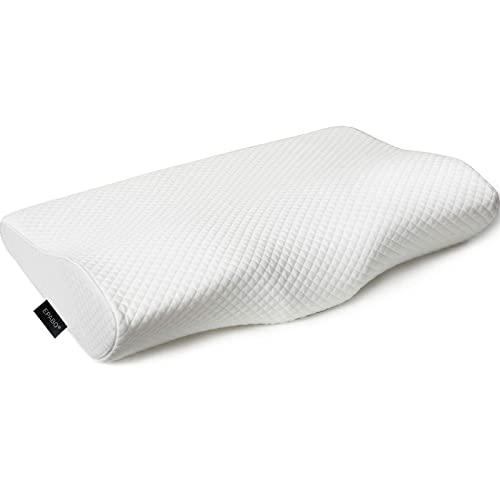
Core
Memory foam
Size
24 x 15 x 4.8 in
Adjustment
Removable center section
Shape
Queen contour
Core care
Do not wash
EPABO uses a larger queen contour and a removable center section. Taking out that piece lets the head sit lower while preserving the surrounding neck-support geometry, making it one of the more practical structured options for sleepers who need a little less center height.
The customer evidence is useful because it speaks directly to fit: the removable section made the pillow work better for multiple sleepers, while the larger footprint was awkward on smaller beds. Long-term durability reports are also encouraging, but that does not override the need for the contour to match your body.
Why it works
- Removable center section lowers the head cradle.
- Wide queen shape gives more lateral space.
- Defined contour stays in place better than loose fill.
- Outer cover is easier to clean than the foam core.
What to keep in mind
- Overall pillow size can be larger than expected.
- The foam core should not be machine washed.
- A wide contour may still be wrong for a short neck or narrow shoulders.
3 / 6
DONAMA Cervical Pillow

Core
Polyurethane foam
Shape
Dual-height contour + arm grooves
Size
Queen
Best evidence
Side sleeping
Cover
Breathable
DONAMA adds arm grooves to its dual-height cervical shape. That makes it distinct from a simple neck wave: side sleepers have somewhere to place the upper arm rather than bunching the shoulder against the pillow edge.
Customer evidence is strongest for side sleeping and keeping the head in a steadier position. Stomach-sleep fit is more mixed, and firmness descriptions range from too flexible to too hard. This is therefore a position-specific choice rather than a universal contour.
Why it works
- Arm grooves address shoulder and hand placement during side sleeping.
- Two height options give basic loft choice.
- Wide contour allows some position changes without leaving the pillow.
- Breathable cover handles the contact surface.
What to keep in mind
- Stomach sleepers have less convincing fit evidence.
- Firmness is highly subjective.
- Structured arm grooves may feel restrictive to restless combination sleepers.
4 / 6
Cushion Lab Extra Dense Ergonomic Cervical Pillow

Core
Dense memory foam
Size
23.5 x 15 x 4.3 in
Shape
Head basin + neck ramp + cheek support
Feel
Firm
Cover
Removable cotton
Cushion Lab is the firmest, most deliberately structured option among these picks. A built-in head basin, neck ramp, and raised cheek areas create a fixed cradle rather than asking the sleeper to mold or reshape the pillow.
That architecture can suit back sleepers who want the head held in a stable position. Customer evidence also makes the body-size caveat unusually clear: smaller sleepers can find the neck ramp too long, placing the head on the wrong part of the pillow. Heat retention is another repeated concern despite the breathable cover.
Why it works
- Dense foam provides a stable, non-fluffy support surface.
- Head basin keeps the back-sleeping position defined.
- Raised side areas create a separate geometry for side sleeping.
- Removable cover simplifies surface washing.
What to keep in mind
- Firmness is intentionally high.
- Neck ramp can be too long for smaller bodies.
- Dense foam may retain more heat than expected.
- Fixed geometry offers no insert-based height adjustment.
5 / 6
Osteo Cervical Pillow
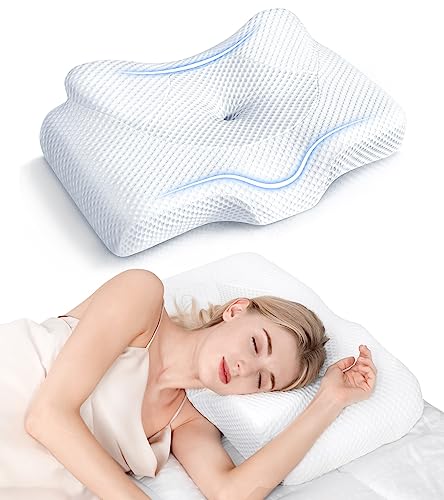
Core
Memory foam
Size
25.5 x 16.5 in
Heights
5.2 / 4.1 in stated
Adjustment
Rotate 180 degrees
Shape
Hollow center
Osteo is the largest stated contour here and switches between roughly 5.2 and 4.1 inches simply by rotating the pillow. The hollow center gives back sleepers a defined place for the head without removable components.
Customer evidence supports stable back-sleep positioning for some users, including a head cradle that does not flatten through the night. Side-sleep comfort is less consistent, and newer-version support has disappointed some repeat buyers.
Why it works
- Large high/low difference is easy to test.
- Hollow center provides a defined back-sleep head position.
- No removable parts to lose.
- Breathable feel is supported by some customer evidence.
What to keep in mind
- Large footprint and higher profiles may be too much for smaller sleepers.
- Side sleeping is less consistently comfortable.
- Long-term/version consistency is mixed.
6 / 6
Coop Home Goods Original Adjustable Pillow

Fill
Cross-cut memory foam + microfiber
Shape
Traditional rectangle
Size
Queen
Loft
Fully adjustable
Extra fill
Included
Coop is the outlier because it is not a cervical contour at all. Instead, you change the loft by removing or adding shredded memory-foam and microfiber fill. That gives sleepers more freedom if a molded cradle feels too restrictive.
The tradeoff is structure. Some sleepers value the customization, while others specifically looking for stronger neck positioning find it no more supportive than an ordinary soft pillow. The queen size can also feel too wide or bulky.
Choose Coop if you think height is the problem and want to experiment with loft. Choose a cervical design if you know you want a defined neck ramp or head cavity.
Why it works
- Continuous fill adjustment lets you tune head height gradually.
- Traditional shape allows more freedom to move.
- Extra fill is included for higher or firmer setups.
- Shredded construction can be molded under the neck.
What to keep in mind
- It does not provide a fixed cervical cradle.
- Soft fill can feel insufficiently structured.
- Queen-only size may be too large for some beds.
- Fill needs occasional fluffing and redistribution.
How to Choose a Pillow When Neck Comfort Is the Priority
Start with the height you already tolerate
A specialty shape will not help if it raises or lowers the head too far. Use your current pillow as a reference: does your head feel pushed forward, dropped back, or tilted to one side? That gives you a better starting point than a generic "orthopedic" label.
Decide whether you want geometry or adjustability
A cervical contour gives your head and neck predetermined places to rest. An adjustable-fill rectangle gives you less guidance but more freedom. If previous molded pillows have felt restrictive, adjustable loose fill may be a better experiment.
Match the neck ramp to your body
A contour can be the right height and still fail if the neck section is too long or too short. Smaller sleepers should pay particular attention to where the head basin begins relative to the neck ramp.
Give foam time to expand and acclimate
Compressed foam needs its stated recovery period. Some firm designs also feel different after several nights. That said, persistent discomfort is not something you need to "push through" indefinitely; it may simply be a poor geometry match.
Separate comfort evidence from medical claims
Individual buyers often describe changes in pain, headaches, numbness, or other symptoms. Those experiences are personal and do not establish that a pillow treats a condition. Use them only as evidence that fit and comfort can vary dramatically.
Frequently Asked Questions
What type of pillow is best for neck pain?
There is no universal best type. A pillow should keep your head at a comfortable height for your sleep position and provide enough support without forcing the neck into an awkward contour. Some sleepers prefer cervical foam; others do better with adjustable traditional fill.
Is a cervical pillow better than a regular pillow?
It can be if the contour matches your body and preferred position. A poorly matched cervical shape can be less comfortable than a correctly adjusted regular pillow.
Should a neck-support pillow be firm?
It needs enough structure to resist unwanted collapse, but extra-firm is not automatically better. A surface that creates pressure or forces the head into the wrong position is a poor fit regardless of firmness label.
How long should I try a cervical pillow?
Give compressed foam the proper expansion time and allow a short adjustment period if the shape feels unfamiliar. If the pillow consistently makes your sleep less comfortable or symptoms worse, reassess the fit rather than assuming longer use will solve it.
When should neck pain be evaluated professionally?
Seek appropriate medical advice for pain that is severe, persistent, worsening, follows an injury, or comes with concerning symptoms such as weakness, numbness, fever, severe headache, or other neurological changes.
For more structured contour options, see the best cervical pillows. If you prefer to tune loft instead, compare the best adjustable pillows.
